
Exploring the Forest: Insights from Vegetation Plots, by Martin Bofeko and Francesca Grillo
Vegetation plots are a key method for studying forest ecosystems. These carefully measured sections of forest allow researchers to record the trees, lianas, and herbs present, as well as their abundance and distribution. The data collected provides valuable insights into forest productivity, wildlife food availability, and the diversity of plants that can be used even for medicine or human consumption.
What is a Vegetation Plot?
A vegetation plot is typically a 50 by 50 meter square where all plant species are identified and catalogued. Each plot provides a detailed snapshot of the forest, helping to compare different landscapes and forest types. Some plots are located in periodically flooded or secondary forests, where lianas – woody climbing plants – are particularly abundant. In mature primary forests, trees are more dominant, and the mix of species is different.
For the BonDiv project, at least 100 plots are surveyed across the research area, with data collected in two rounds to ensure thorough coverage. Plots not only record plants consumed by bonobos but also document medicinal species, edible wild plants, and other useful plants, providing a comprehensive view of the forest’s resources.
Understanding Trees and Lianas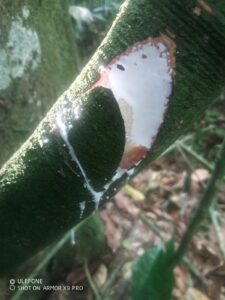
Lianas are climbing woody plants that can be difficult to identify because many appear similar at first glance. Key characteristics for identification include the colour of the sap (white, red, yellow, or coffee-coloured, etc.), the texture of the bark (fibrous, granular, or soft), and the scent, which can range from sweet to banana, onion, or chili-like aromas. Some lianas even provide drinkable water, and this in itself is also an indicator of the family which they belong to.
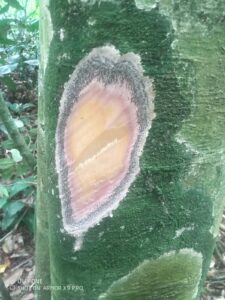
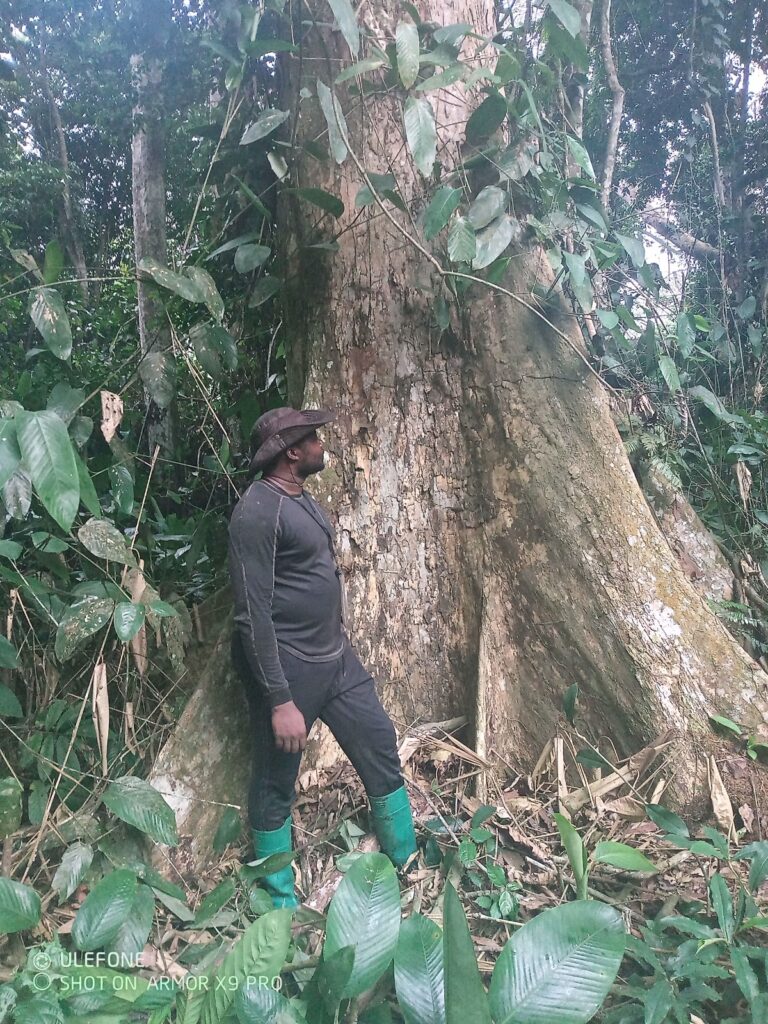
Trees are often easier to distinguish than lianas, yet they reveal their identity through a fascinating combination of features. Roots can take many forms – stilt-like, buttressed, columnar, or spreading wide at the base – each adapted to the tree’s environment. Trunks are usually cylindrical or straight, sometimes adorned with peeling bark (desquamation) or textured layers of dead tissue (rhytidomes). Crowns display remarkable diversity, from umbrella-shaped canopies that shelter the forest floor, to conical, spherical, or tiered crowns that catch sunlight in different ways. Leaves, whether simple or compound, follow distinct patterns (phyllotaxy) that help pinpoint species, while exudates – sap or latex in hues of white, red, or yellow – can also provide crucial clues.
Working in Plots
Conducting vegetation plots demands careful observation and attention to detail. Reaching remote corners of the forest can be physically challenging, but it is deeply rewarding, offering a chance to witness its richness firsthand. Studying these plants reveals the forest’s delicate balance, its support for wildlife like bonobos, and invites us to marvel at the quiet wonders around us — from towering trees to lianas weaving through the canopy.
January 2026, by Martin Bokeko and Francesca Grillo. This article is based on the botanical expertise of Martin, with additional collaboration from Francesca.